Anatomy of a successful AI response: keys to optimizing your brand
Discover how to build AI responses that not only rank high on Google but are also cited by models like ChatGPT and Perplexity, boosting your brand's visibility and authority in the era of generative search.
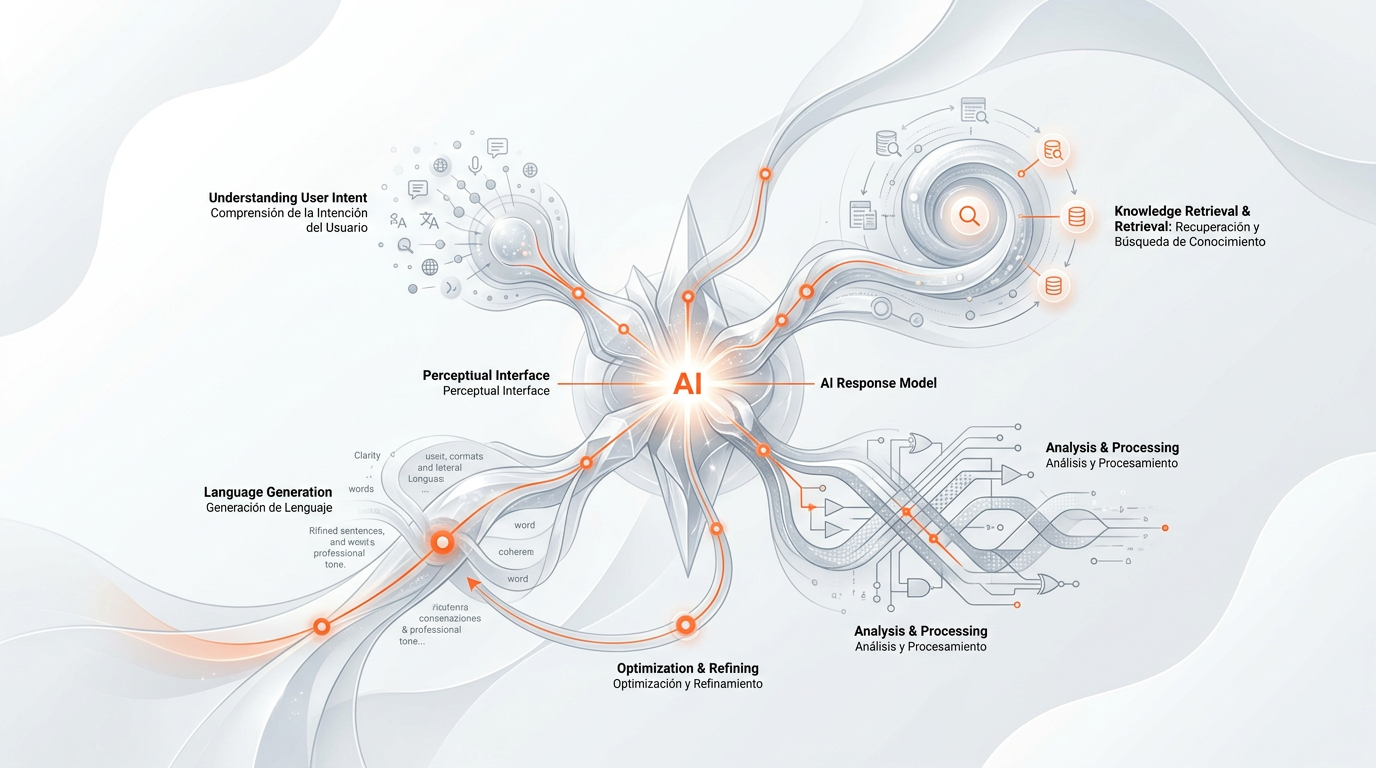
Anatomy of a successful AI response: keys to optimizing your brand
The success of an AI response lies in its ability to directly satisfy user intent with accurate and authoritative information, formulated concisely and structured to be easily processed by both traditional search engines and generative language models (LLMs). By mastering this anatomy, brands can ensure their relevance and authority in today's digital landscape.What defines an optimized response for AI and generative search engines?
An optimized response is one that balances content accuracy with technical formability, designed to be understood and valued by search algorithms and LLMs. It not only directly and authoritatively answers the user's query but also presents the information in a structured format that facilitates its extraction, interpretation, and citation, elevating organic visibility and source authority."True optimization for the AI era is not just about keywords, but about crystallizing your brand's truth into a digestible format for the machines that mediate knowledge." — Industry experts in Generative SEO.
Key strategies for building citable and rankable AI responses
For your content not only to appear but to be the chosen and cited answer, it is essential to adopt a multifaceted approach that combines traditional SEO with the new demands of generative search. Here's how:1. Direct Answer First: The Primacy of Conciseness
The first paragraph of your content should be a direct, concise, and complete answer to the main question. LLMs and Featured Snippets prioritize information that immediately resolves search intent. Think of it as the "executive summary" of your content.
2. Semantic Structuring and Rich Data
Organize your content with a clear hierarchy of headings (H1, H2, H3), use ordered lists (<ol>) and unordered lists (<ul>), and tables (<table>) to present complex data in a readable way. This not only improves the user experience but also facilitates information extraction by LLMs. Implementing Schema Markup (JSON-LD) for FAQs, How-To, and Q&A is crucial for structured visibility.
- Use Schema Markup for relevant content types.
- Bold key phrases to highlight important points.
- Short paragraphs and direct sentences.
3. Authority and Evidence: The Backbone of Trust
The most cited AI responses come from demonstrably authoritative sources. Include expert quotes, links to research studies, statistical data, and, of course, references to your own experience and data (e.g., "According to GEOConsole data"). This builds E-E-A-T (Experience, Expertise, Authoritativeness, Trustworthiness), a critical factor for Google and LLMs.
4. Natural Language and Conversational Tone
Although optimized for machines, the content should sound natural and human. LLMs are trained on natural language, so a conversational and accessible tone improves the chances of your content being selected as the authoritative "voice" for a response.
5. Exhaustive but Focused Topic Coverage
Cover the topic in depth, addressing related questions and subtopics, but always staying focused on the main intent. This positions your content as the definitive resource on the topic, increasing its value for LLMs looking for comprehensive answers.
Comparison: Traditional SEO vs. Generative AI Optimization
Evolution in search demands a paradigm shift. Here's a comparison of approaches:| Characteristic | Traditional SEO (Classic Google) | Generative AI Optimization (LLMs/SGE) |
|---|---|---|
| **Main Goal** | Rank in the top 10 results | Be the direct cited answer / appear in SGE |
| **Emphasis on Keywords** | Keyword density, long-tail | Semantic intent, natural questions |
| **Content Structure** | H1-H6, paragraphs, bolding | Direct Answer First, Schema Markup, Lists, Tables |
| **Success Metric** | Organic traffic, CTR | LLM citations, SGE visibility, brand authority |
| **Source of Authority** | Quality backlinks, domain | E-E-A-T, original data, expert citations |
What are the common mistakes when trying to optimize for generative search?
Avoiding these pitfalls is as important as applying best practices:- **Keyword Stuffing**: Filling content with keywords unnaturally harms readability and credibility. LLMs look for fluency and coherence.
- **Lack of "Direct Answer"**: Not providing a concise answer at the beginning frustrates LLMs, which seek to extract the essence quickly.
- **Absence of Sources or Authority**: Content without expert backing or verifiable data is less likely to be cited.
- **Poor Formatting**: Monolithic text or text without clear structure is difficult for LLMs to process.
- **Generic or Superficial Content**: Successful AI responses delve deep into the topic, offering real and unique value.
Ignoring these points can result in your content, despite being relevant, being overlooked by AI algorithms in favor of better-optimized sources.