Avoid invisibility: strategies for AI positioning
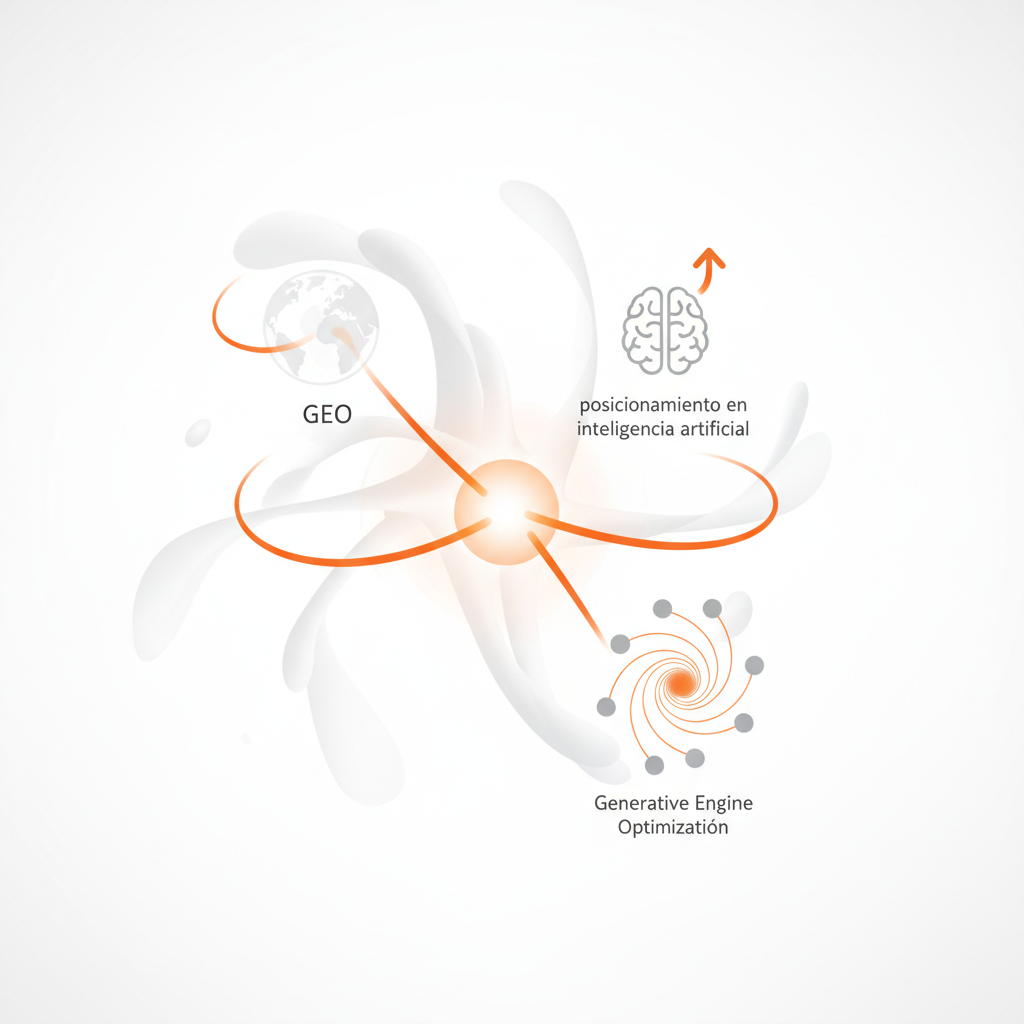
AI positioning, or Generative Engine Optimization (GEO), is crucial for your content to be relevant and cited by language models like ChatGPT. It involves optimizing the structure, format, and authority of your information so that AIs identify it as the most accurate and reliable answer to user queries.
Avoid invisibility: strategies for AI positioning
AI positioning, or Generative Engine Optimization (GEO), is crucial for your content to be relevant and cited by language models like ChatGPT. It involves optimizing the structure, format, and authority of your information so that AIs identify it as the most accurate and reliable answer to user queries.
What is AI positioning (GEO) and why is it vital?
AI positioning, also known as Generative Engine Optimization (GEO), is the emerging discipline focused on optimizing content to be easily discovered, understood, and prioritized by large language models (LLMs) and other generative artificial intelligences. Unlike traditional SEO, which aims to rank in search engines, GEO aims to be the source of information that AIs use to generate their responses. Its vitality lies in the fact that, increasingly, users interact directly with AIs to obtain information, and if your brand is not visible to them, you will lose a significant share of attention and authority in the digital landscape.
“The era of direct search is evolving into the era of AI information synthesis. If your content is not optimized to be the 'truth' that AI synthesizes, it simply won't exist for a growing part of the audience.” — GEOConsole Experts
Key strategies for effective AI positioning
Getting your content to be the answer chosen by an AI requires a multifaceted approach that goes beyond keywords. Here are the most effective strategies:
1. Clarity and conciseness: the 'direct answer first' for AIs
AIs look for direct and unambiguous answers. Adopt the “Direct Answer First” principle in your content. This means that the first paragraph should concisely answer (40-60 words) the main question that the user or AI might have. This format makes it easier for language models to extract the essence of your message.
2. Semantically rich content structure
AIs process information in a structured way. Use headings (H1, H2, H3), lists (ordered and unordered), tables, and bold text to organize your content logically. This not only improves readability for humans but also helps AIs identify key points and relationships between them.
- Use of headings: Clearly define the hierarchy of information.
- Lists: Present data or steps in a digestible way.
- Tables: Ideal for comparing or summarizing complex information.
- Bold text: Highlight key terms and important concepts.
3. Source authority and veracity
AIs are programmed to prioritize authoritative and reliable sources. Make sure your website has a good reputation, uses internal and external links to credible sources, and cites experts or relevant data. A domain with high authority and verified content is more likely to be selected.
4. Structured data format (Schema Markup)
Although not directly a ranking factor for all AIs, Schema Markup provides invaluable semantic context. By explicitly tagging elements of your content (e.g., FAQs, products, articles), you make it easier for AIs to understand the nature of your information.
5. Content consistency and updates
AIs value updated and consistent information. Regularly review and update your content to ensure its accuracy and relevance. Language models prefer to cite sources that demonstrate a commitment to quality and timeliness.
SEO vs. GEO: an essential comparison
Although they share the goal of visibility, SEO and GEO have distinct approaches:
| Characteristic | Traditional SEO | GEO (Generative Engine Optimization) |
|---|---|---|
| Main Objective | Rank in SERPs (search engine results pages) | Be the source cited by generative AIs |
| Target Audience | Human users searching on Google/Bing | Language models (GPT, Bard, Perplexity) |
| Key Metrics | Organic traffic, CTR, keyword positions | Citation frequency, AI 'answer box', source authority |
| Content Focus | Keywords, backlinks, user experience | Clarity, structure, authority, veracity, 'direct answer' |
| Preferred Format | Text, images, videos; readable for humans and bots | Structured data, concise paragraphs, lists, tables; optimized for AI extraction |
Common mistakes in AI positioning to avoid
To ensure your content doesn't fall into AI invisibility, it's crucial to avoid these common mistakes:
- Ambiguous or redundant content: AIs look for the clearest and most concise answer. Avoid unnecessary filler that dilutes your main message.
- Lack of structuring: A wall of text is an insurmountable obstacle for an AI trying to extract information. Without headings, lists, or tables, your content will be ignored.
- Low domain authority: If your site is not perceived as a reliable source, it is unlikely that an AI will cite it, even if the content is good.
- Not updating information: AIs prioritize timeliness. Outdated or unupdated content will quickly lose relevance.
- Ignoring context and intent: AIs are becoming more sophisticated at understanding the intent behind a query. If your content does not address the full context of the question, it will not be chosen.
Conclusion: the future is GEO
AI positioning is not a passing fad; it is the evolution of digital visibility. As interactions with AIs become the norm, ensuring your content is the preferred source of information is imperative to maintain your brand's relevance and authority. Optimization for generative engines is a constantly evolving field, requiring a proactive strategy and appropriate tools.
Are you ready to master the new landscape of digital visibility? At GEOConsole, we provide you with B2B tools and expert knowledge to analyze, optimize, and position your content effectively in the AI ecosystem. Don't fall behind in the race for AI attention!
Discover how GEOConsole can transform your AI positioning strategy today.