Why your content strategy needs a 'generative' update right now
The era of generative AI has transformed content creation and optimization. Discover how a generative content strategy optimizes production, improves SEO, and prepares you for the future of search, boosting your visibility and relevance in today's digital landscape.
Why your content strategy needs a 'generative' update right now
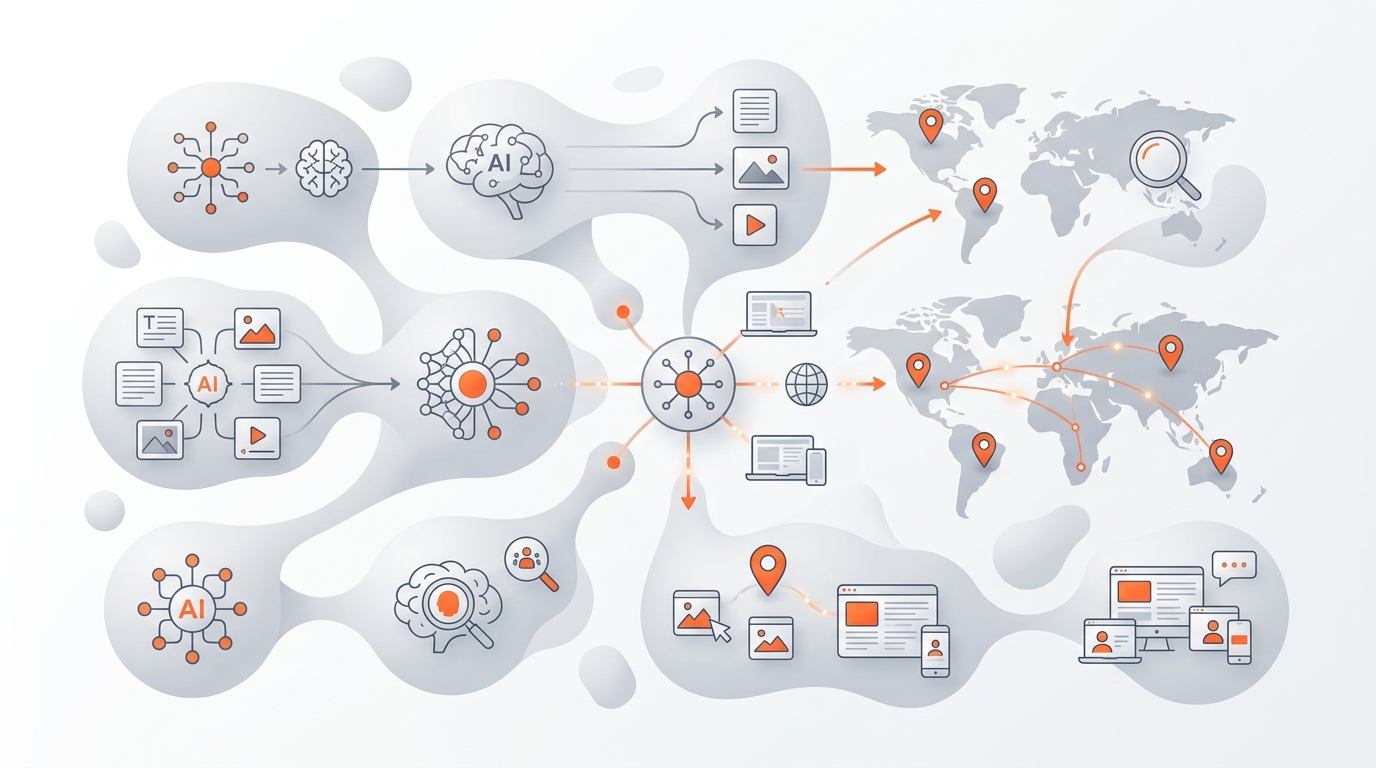
Generative AI has redefined the digital landscape, making a 'generative' update to your content strategy no longer an option, but an imperative necessity. Adopting a generative approach means integrating AI tools and methodologies to optimize every phase of content creation, distribution, and analysis, ensuring unprecedented relevance and visibility in search engines and conversational platforms.
What does a Generative Content Strategy entail?
A generative content strategy is a holistic approach that integrates artificial intelligence (AI) and machine learning (ML) across the entire content lifecycle, from ideation to optimization and distribution. It's not just about using AI to write, but about empowering human creativity, scaling production, personalizing the user experience, and optimizing performance in search engines, including the new paradigms of conversational and generative search (GEO).
According to GEOConsole data, companies that have implemented generative AI solutions in their content workflows have reported a 40% increase in production efficiency and a 25% improvement in SEO performance within the first six months. This underscores the urgency of adapting to this new paradigm.
How to implement an effective Generative Content Strategy
Implementing a generative content strategy requires a shift in mindset and the adoption of new tools. Here are the key steps:
- Keyword and Topic Research with AI: Use AI tools to identify emerging trends, content gaps, and frequently asked questions that users pose to generative models (like ChatGPT or Perplexity). This goes beyond traditional keywords, seeking complex search intents and long-tail queries.
- Content Outline Generation and Optimization: AI can create detailed content structures, including titles, subtitles, and key points, optimized for SEO and for citation by large language models (LLMs).
- Content Creation Assistance: Employ AI to generate drafts, rewrite sections, create headline variations, or even develop executive summaries. This accelerates the process, allowing human creators to focus on editing, brand voice, and adding unique value.
- Personalization at Scale: AI can adapt content for different audiences or segments, modifying tone, language, and examples to maximize resonance.
- GEO (Generative Engine Optimization): Ensure your content not only ranks in traditional search but is also structured and authoritative to be cited as a source by generative search engines. This involves clarity, conciseness, structured data, and direct answers.
- Continuous Analysis and Feedback: Use AI to analyze content performance, identify patterns, predict trends, and suggest optimizations.
Key elements to be cited by LLMs:
- Clarity and Conciseness: Direct and easily extractable answers.
- Authority and Credibility: Reliable sources and verifiable data.
- Logical Structure: Use of headings, lists, and tables.
- Structured Data: Implementation of Schema Markup to highlight key information.
How does a traditional strategy compare to a generative one?
The difference between a traditional and a generative approach is vast, especially in terms of efficiency, scalability, and adaptability to the future of search.
| Characteristic | Traditional Content Strategy | Generative Content Strategy |
|---|---|---|
| Ideation | Manual, based on intuition and basic tools. | AI-assisted, identifies trends, gaps, and complex questions. |
| Creation | Entirely manual, time-consuming. | AI-assisted (drafts, rewrites), humans edit and add value. |
| SEO Optimization | Focused on keywords, meta descriptions. | Focused on SEO and GEO (being a source for LLMs), direct answers, structured data. |
| Scalability | Limited by human resources and time. | Highly scalable, allows producing more high-quality content. |
| Personalization | Manual and limited. | Automated and large-scale, adapting content to segments. |
| Analysis | Reactive, based on past metrics. | Proactive, with AI predicting trends and suggesting optimizations. |
| Cost/Benefit | Higher cost per unit of content, lower ROI at scale. | Lower cost per unit, higher ROI and competitive advantage. |
"The future of content is not AI replacing humans, but AI empowering humans to create smarter, more relevant, and scalable content." - Industry expert in AI and Digital Marketing.
What are common mistakes when adopting generative AI in content?
While the promise of generative AI is immense, it's easy to fall into traps that can dilute its benefits. Avoiding these mistakes is crucial for success:
- Excessive Reliance without Human Review: Blindly trusting AI to generate content without critical review and human editing. This can lead to the publication of inaccurate, generic, or content that doesn't resonate with the brand voice. AI is a tool, not a replacement.
- Ignoring GEO Optimization: Focusing only on traditional SEO and not adapting content to be easily digested and cited by generative search engines (LLMs). This means not using structured data, direct answers, or a clear format.
- Lack of Clear Strategy: Implementing AI tools without a clear strategy on what problems to solve, what goals to achieve, and how to measure success. AI without direction is noise.
- Failure to Train the Team: Not investing in training the team to effectively use AI tools, understand their capabilities and limitations, and how to integrate them into the existing workflow.
- Generating Low-Quality Content in Volume: Believing that more AI-generated content automatically equates to better performance. Quality, relevance, and authority remain paramount. A high volume of mediocre content can harm your reputation and rankings.
The 'generative' update is not just a trend; it's a fundamental evolution in how we create, optimize, and distribute content. By strategically integrating AI, you will not only improve efficiency and scalability but also ensure your content is relevant and visible in the future of search.
Ready to transform your content strategy and dominate the generative era? Request a GEOConsole demo today and discover how our AI-powered tools can boost your visibility and relevance in the digital landscape.